
Greetings,
Dear Readers!
“Your Legal-Tech Brew!” is a blog as cliché as any other blog…. It is an honest attempt towards compiling recent news in cyber-legal space, for the readers to understand right from the basic terminologies to analyzing existing legal framework across dimensions of cyberspace through various brief posts.
(The content of the blog is original work of the author, due credits have been given for the content referred from different sources. The blog is for information purpose only.)
The discussion pertaining to E-notarization has sprouted from the Order of Hon’ble Delhi High Court, where in the case of ‘Grey Swift Private Limited V/s The Registrar of Trade Marks’ where, the application to file ‘electronically signed documents & notarized affidavits’ has been allowed and taken on record. The trend started from the decision in ‘Srinath Kumbargeri Venkatachalappa v. CA Shivaram’ (Feb 2024) by the Delhi High Court, where the documents through e-notarization were accepted because the plaintiff could not appear physically. Furthermore, in another recent case, Singh and Singh Law Firm and Another v. Singh and Singh Attorneys and Others, the Delhi High Court again validated the execution of electronically signed documents while hearing a suit seeking protection of the name “Singh and Singh” in relation to legal services and ruled in favour of the validity of legal documents executed via the e-notarization process and allowed the application.[1]
In the present case, the platform used for such electronic signatures, stamping and paperwork (online) was ‘LEEGALITY’ (can be accessed using: https://www.leegality.com/?gad_source=1&gad_campaignid=13961638469&gbraid=0AAAAADDd9EzVhVEDH3NN74cfe19OKBys5&gclid=CjwKCAjwx8nCBhAwEiwA_z__08-ifM6Jx2Vqnm5jyieQEK9GULpewonFIFdegX0vL8RMf-WLQGIfcBoChVMQAvD_BwE).
Another such platform is ‘Enotarial.com’ (https://enotarial.com/). Enotarial specifically states that it complies with ‘Bhartiya Saksha Adhiniyam’ for ‘certain’ documents to be e-notarized. The modus operandi that the platform follows is that- the individuals are supposed to upload their documents, following which they need to schedule an online session with a certified notary and complete the
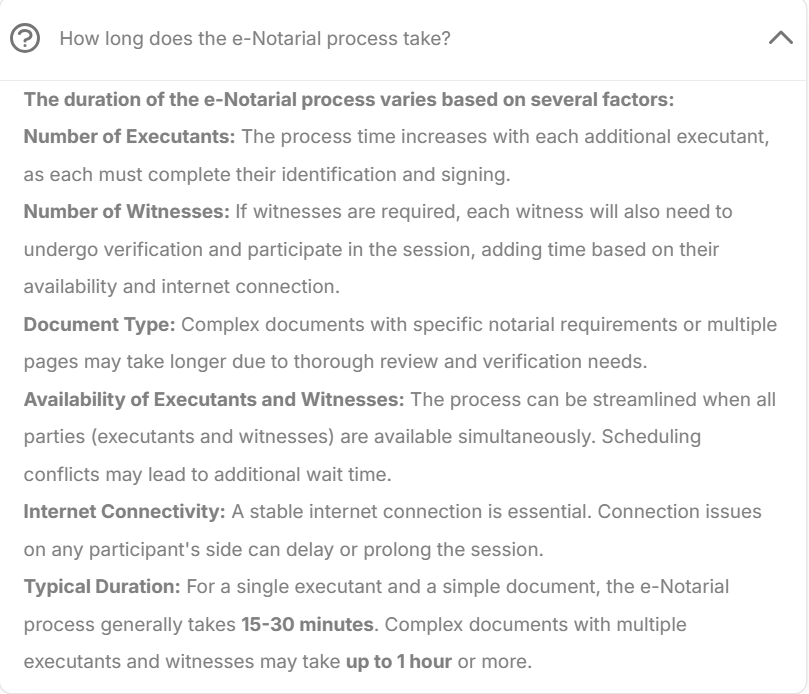
| Figure 1: Screenshot from FAQs taken from https://enotarial.com/. |
process.
Where does the concern lie?
The two major statues intersecting in this issue are ‘Notaries Act, 1952’ and the ‘Information Technology Act, 2000’. Apart from these two, the Bhartiya Saksha Adhiniyam under Sections 61 to 63 provide for admissibility of electronic or digital evidence. It further establishes that “electronically processed documents will have the same legal validity and enforceability as any other documents.”
While Notaries Act do not address the electronically notarised documents specifically, it comes into conflict with the BSA provisions and the practice of accepting e-notarised documents started by the Hon’ble Delhi High Court. The IT Act recognizes electronic records and digital signatures. Section 3(1) of the IT Act provides for ‘the validity of digital records affixed with digital signatures’ and Section 3A outlines the procedure related to electronic signatures. Additionally, e-sign services have been launched by the Central Government to promote digital governance. e-Sign is an online electronic signature service that can be integrated with service delivery applications via an API, facilitating an e-sign user to digitally sign a document. Using the authentication of the e-sign user through the e-KYC service, online electronic signature services are enabled.[2]
Notarization process refers to ‘verifying the authenticity’ of the legal documents and includes the certification and maintenance of record by the Notary Public. It is pertinent to note that the Notaries Act and the IT Act are SILENT on the issue to ‘e-notarization’.
With all the three cases at hand, where the Hon’ble Delhi High has time and again accepted the digitally signed documents and e-notarized documents, raises an imperative question of making this a standard practice or not….
The Hon’ble Apex Court of India has not commented on the same, yet. Therefore, the practice remains at the discretion of the Higher Courts.
GLOSSARY:
Digital signature is “a specific, secure type of electronic signature that uses cryptography to verify the identity of the signer and the integrity of the document”
Electronic signature is “the digital form of a legally binding, wet ink signature”. However, an electronic signature doesn’t have to be an actual, digitized signature. It can be an electronic symbol, sound, or image attached to a contract or record where there is an intention to sign documents by the party involved.[3]
Essentially, all digital signatures are electronic, but not all electronic signatures are digital.
[1] https://www.irccl.in/post/establishing-legal-clarity-the-need-for-comprehensive-guidelines-in-e-notarization
[2] https://www.irccl.in/post/establishing-legal-clarity-the-need-for-comprehensive-guidelines-in-e-notarization
[3] https://www.proof.com/blog/whats-the-difference-between-electronic-and-digital-signatures
📎
(The blog and content therein including the figures, is an original work of the author, using the content without prior permission from the author is not encouraged.)
 YLTB!
YLTB! 
Leave a comment