
Today marks 10 years of the ‘Digital India’ Mission. ‘Power To Empower’ being its tagline, the journey made India rank third in the world for ‘digitalization of economy’[1].
India had always been between this digital divide as compared to the other nations, but as of today, over 55% Internet penetration has taken place since 2014. The total number of internet users in 2025 is around 97 Crores.
By 2030, India’s digital economy is projected to contribute nearly one-fifth of the country’s overall economy, outpacing the growth of traditional sectors.[2]
Some of the well known features of the Digital India project were- Cradle to Grave digital identity; Mobile phone & Bank accounts; Cloud Accessibility; Electronic & Cashless Financial Transactions (UPI transactions) and Cloud Accessibility for all Documents and Certificates (Cloud services such as the ‘APAAR’ Automated Permanent Academic Account Registry.)
The winner moves of the project:
- UPI: As per the Ministry of Finance, in April 2025, over 1,867.7 crore UPI transactions worth ₹24.77 lakh crore were made in one month. According to the ACI Worldwide Report 2024, India handled 49% of global real-time transactions in 2023
- Aadhaar: The Aadhaar-based e-KYC system has helped simplify processes in both banking and public services. It made verification faster, reduced paperwork, and brought transparency across sectors. As of April 2025[1], 142 crore Aadhaar IDs have been generated.[3]
- BharatNet: As of January 2025, BharatNet has connected over 2.18 lakh Gram Panchayats with high-speed internet. Nearly 6.92 lakh km of optical fibre cable has been laid, bringing internet to many villages.
- AI Mission: Approved on 7 March 2024, the IndiaAI Mission aims to build a strong and inclusive AI ecosystem with a budget of ₹10,371.92 crore over five years.
Apart from these, India’s Semiconductor Mission, E-Governance (DigiLocker) and an innovative platform BHASHINI which allows people across the nation to access the digital services in their own language, a total of 18 languages have been provided in the platform; has made significant change, to how we use the internet and how the digitalization impacts our economy. Flagship schemes like PM-KISAN, e-Shram, and One Nation One Ration Card (ONORC) now operate on digital rails, ensuring benefits reach the last mile with efficiency and transparency.[4]
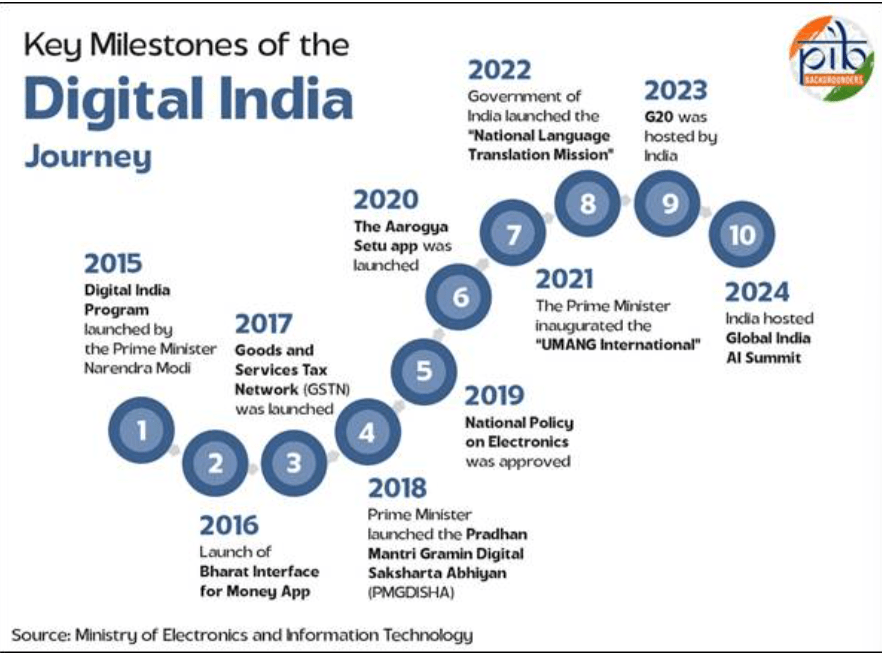
The initial years of Digital India focused on laying a digital backbone, where the usage of terms such as Aadhaar, UPI, DigiLocker had become household names. Today, AI Platforms such as DIKSHA and Ayushman Bharat (predictive diagnostics), 5G expansion, Skill India Digital Hub, G20 AI Framework, the Digital Data Protection Act, 2023 and Rules, 2025 are all inclusive of the Digital India Mission.
[1] State of India’s Digital Economy Report 2024, released by ICRIER
[2] Pib.gov.in (Press Note)
[3] Pib.gov.in (Press Note)
[4] https://government.economictimes.indiatimes.com/blog/digital-india-celebrating-10-years-of-transformative-tech-and-the-rise-of-tech-swaraj/122124533
(The content of the blog is original work of the author, due credits have been given for the content referred from different sources. The blog is for information purpose only.)
(The blog and content therein including the figures, is an original work of the author, using the content without prior permission from the author is not encouraged.)
 YLTB!
YLTB! 
Leave a comment